Sensor-Enforced Android Focus Timer
Native Android focus timer where sessions only progress while the phone is placed face down and stable, using sensors, foreground service orchestration, local-first persistence, and explicit session semantics.
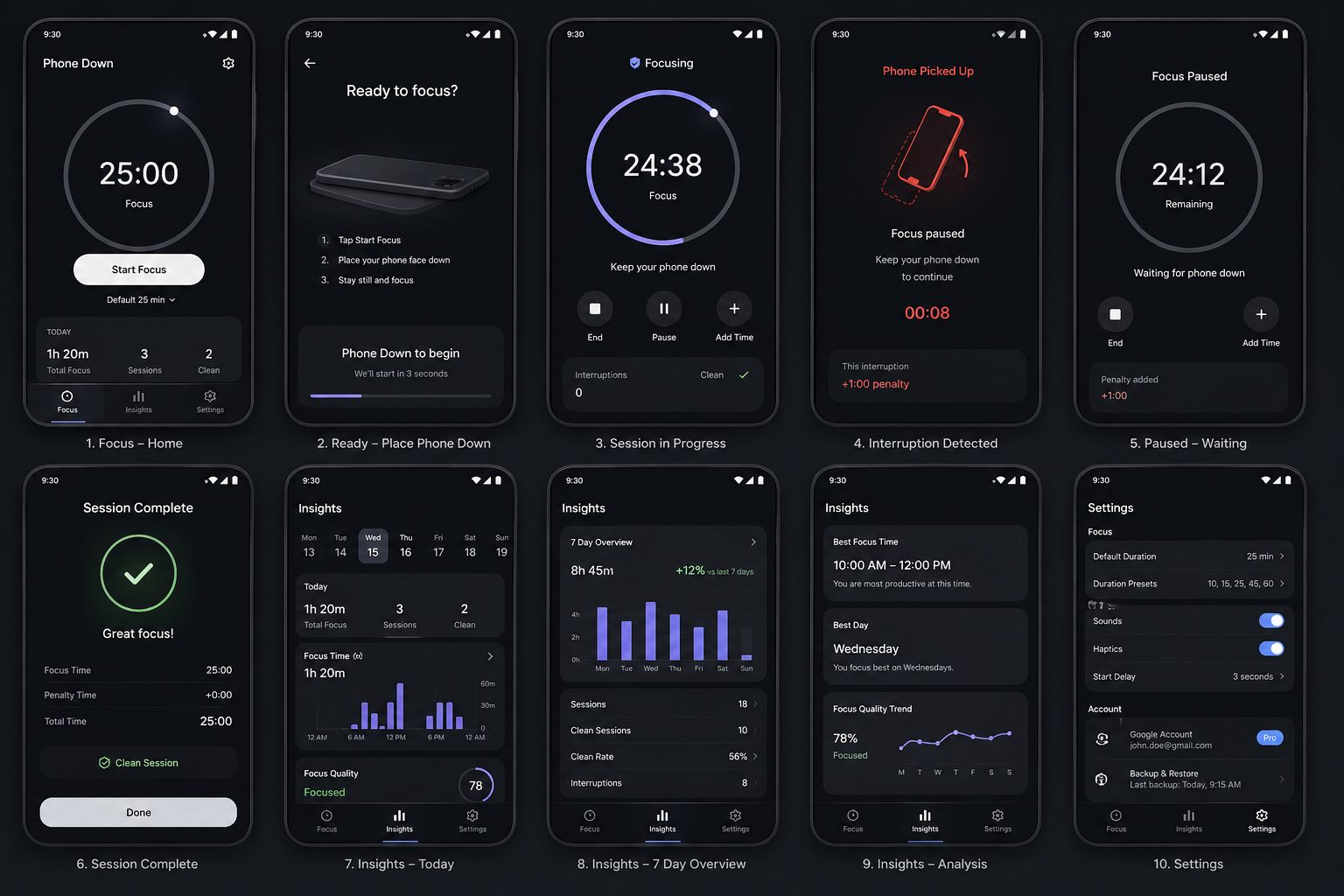
The Challenge
Most focus timers trust the user to ignore the phone, but the phone itself is the distraction. Phone Down turns focus into a physical ritual: place the phone face down and keep it stable.
Architecture & Approach
Multi-module native Android app with Compose feature modules, a pure domain session engine, Room session history, DataStore settings, sensor evaluation, foreground service runtime, notifications, and local-first privacy boundaries.
Separated strict timing and interruption rules from UI rendering. The app edge translates Android sensor, call, service, and notification signals into domain inputs, while the domain engine decides legal session transitions.
My Role & Contributions
Designed and implemented the product architecture, session semantics, module boundaries, focus UI, persistence model, release-readiness documentation, and verification workflow.
Key Technical Decisions
- Made the focus mechanism sensor-enforced so elapsed focus time only accumulates when the device is face down and stable.
- Kept core session rules in pure domain modules to make interruption handling and recovery testable without relying on UI state.
- Chose local-first Room and DataStore persistence so the app works without login, cloud access, billing, or network connectivity.
Results & Impact
Local-first
Privacy Model
Multi-module
Android Architecture
Internal Test
Release Readiness
- Implemented focus states including waiting, arming, active, paused, completed, interruption, and recovery flows.
- Built insights, streaks, clean-session tracking, settings, onboarding, privacy policy, and pro/paywall foundations.
- Documented release readiness with lint, unit tests, Paparazzi screenshot checks, Compose UI-test coverage, and release build verification.
Phone Down demonstrates native Android systems thinking: sensors, foreground services, local persistence, domain state machines, privacy constraints, modular architecture, and release discipline.
Lessons Learned
When behavior depends on real device signals, product correctness has to live below the UI. Explicit state machines and conservative recovery rules make the app more honest and trustworthy.
Interested in similar engineering or AI agent work?
I'm currently looking for Senior SWE and AI Engineering roles. Let's discuss how I can help your team ship systems that scale.