Production AI Agents for Research Analysts
Production AI agents that perform NLP-to-SQL conversion, NLP-based searches, Neo4j knowledge graph construction, auto-build dashboards on Apache Superset, RAG-based Q&A on chart data, and anomaly and pattern detection.
Confidentiality Note: Details have been generalized to respect employer confidentiality and non-disclosure agreements, while preserving the core system architectures, trade-offs, and business impacts.
The Challenge
Research analysts needed to query massive datasets, build visualizations, and detect patterns without depending on specialist engineering teams for every request.
System Architecture
Architecture & Approach
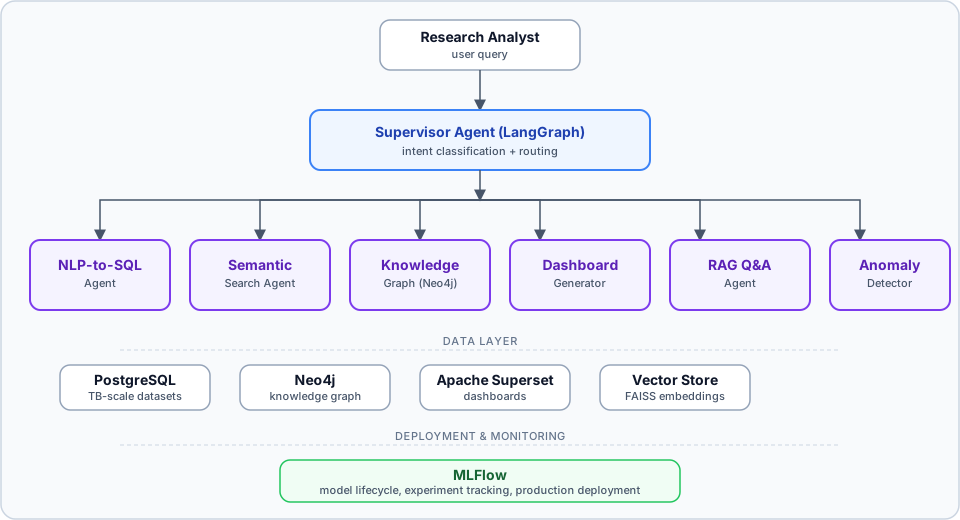
LangGraph supervisor pattern orchestrating specialized agents for NLP-to-SQL, semantic search, knowledge graph construction, Superset dashboard generation, RAG Q&A, and anomaly detection.
Implemented intent routing through a supervisor agent, introduced strict guardrails and retries, and deployed each capability as independently testable modules for reliability.
My Role & Contributions
Lead AI Agent Engineer designing the multi-agent architecture, orchestration policies, and production deployment flow through MLFlow.
Key Technical Decisions
- Used supervisor-based orchestration to isolate failures in a single sub-agent without collapsing the full workflow.
- Adopted graph-state execution so each user task could persist context across chained agent actions.
- Split retrieval, generation, and visualization steps to control latency and make debugging production traces easier.
Results & Impact
Production
Deployment Status
Multi-Agent
Architecture Pattern
Hours -> Seconds
Insight Latency Shift
- Agents deployed to production and used by research analysts.
- Time-to-insight dropped from manual multi-step workflows to near real-time responses.
- New capabilities can be added by introducing new sub-agents without rewriting the core orchestration layer.
The platform moved from a static analytics workflow to an AI-assisted insight engine, increasing analyst throughput while preserving enterprise reliability requirements.
Lessons Learned
Production AI systems require strong orchestration semantics, observability, and fallback strategy. Demo-style prompt chaining is not enough at enterprise scale.
Related Technical Writing
Interested in similar engineering or AI agent work?
I'm currently looking for Senior SWE and AI Engineering roles. Let's discuss how I can help your team ship systems that scale.