Building Production AI Agents with LangChain and LangGraph
AI demos are everywhere. Production AI agents are not. The gap between a ChatGPT wrapper and a system that handles thousands of enterprise queries daily — with reliability, cost control, and sub-second latency — is enormous.
Over the past year at TransUnion, I've been leading the Insights AI Agent Team, building agents that operate on proprietary financial data at scale. This post shares the architectural patterns, tooling decisions, and hard-won lessons from that journey.
Why Enterprise AI Agents Are Different
Most AI agent tutorials show a single LLM call with a tool. Enterprise agents face a fundamentally different reality:
- Reliability requirements: A hallucinated SQL query against a production database isn't a fun demo bug — it's a compliance incident.
- Cost at scale: GPT-4 at $30/1M output tokens across thousands of daily queries adds up. You need tiered model strategies.
- Latency budgets: Dashboards need answers in seconds, not the 30+ seconds a naive agent chain takes.
- Data sensitivity: Financial data can't leave your VPC. Self-hosted models and careful prompt design are non-negotiable.
These constraints shaped every architectural decision we made.
The Agent Architecture: LangGraph Supervisor Pattern
We use LangGraph — LangChain's graph-based orchestration framework — to build a supervisor-routed multi-agent system. Here's the high-level structure:
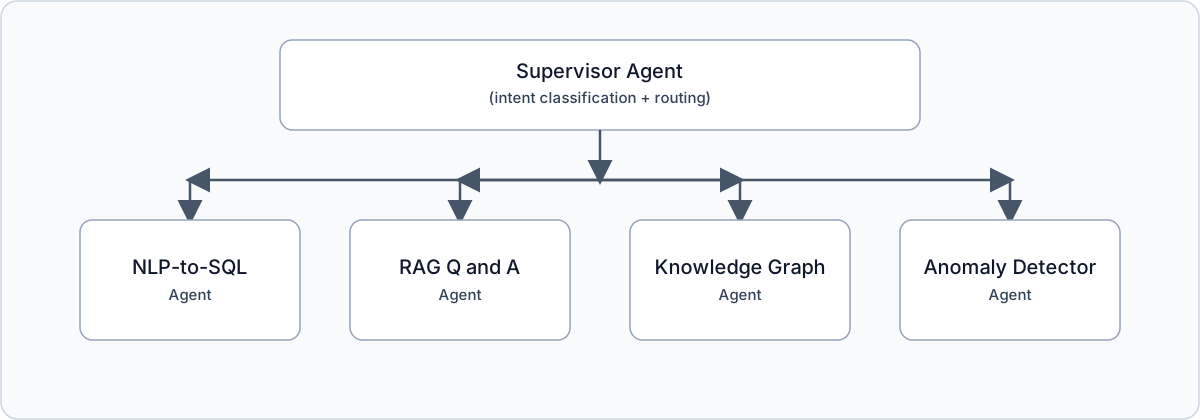
Why a supervisor, not a single monolithic agent?
Separation of concerns. Each agent is a specialist:
- NLP-to-SQL Agent: Translates natural language questions into SQL queries against our data warehouse. Uses schema-aware prompting and query validation before execution.
- RAG Q&A Agent: Retrieval-augmented generation over internal documentation and research reports. Uses FAISS for vector search with chunk-level citation tracking.
- Knowledge Graph Agent: Builds and queries Neo4j graphs for entity relationship exploration — "Show me all companies connected to X through Y."
- Anomaly Detection Agent: Identifies missing patterns and statistical outliers in time-series financial data.
- Dashboard Generation Agent: Produces Apache Superset dashboard configurations from natural language requests.
The supervisor classifies intent in a single cheap LLM call, then routes to the appropriate specialist. This keeps each agent's prompt focused and its tool set minimal — both critical for reliability.
Graph State and Conditional Routing
LangGraph gives us stateful, conditional execution graphs — far more control than a simple chain:
from langgraph.graph import StateGraph, END

workflow = StateGraph(AgentState)

# Add nodes (each is an agent or processing step)
workflow.add_node("supervisor", supervisor_node)
workflow.add_node("nlp_to_sql", nlp_sql_agent)
workflow.add_node("rag_qa", rag_agent)
workflow.add_node("knowledge_graph", kg_agent)
workflow.add_node("anomaly_detector", anomaly_agent)

# Conditional routing from supervisor
workflow.add_conditional_edges(
    "supervisor",
    route_by_intent,
    {
        "sql_query": "nlp_to_sql",
        "document_qa": "rag_qa",
        "entity_search": "knowledge_graph",
        "anomaly_check": "anomaly_detector",
        "done": END,
    },
)
The key insight: the graph is the architecture. Adding a new agent type means adding a node and a routing condition — not rewriting the entire system.
NLP-to-SQL: The Hardest "Simple" Problem
Translating natural language to SQL sounds straightforward until you try it against a schema with 200+ tables and proprietary column names like cr_scr_v2_adj.
What works
- Schema-aware prompting: We inject only the relevant table schemas (not the entire warehouse) based on the user's question. A lightweight classifier picks the top 3–5 relevant tables.
- Query validation layer: Before execution, generated SQL is parsed and validated — checking for valid table/column references, preventing dangerous operations (DROP, DELETE), and enforcing row limits.
- Few-shot examples per domain: Instead of generic SQL examples, we maintain domain-specific few-shot banks. "What's the default rate for segment X?" maps to very different SQL than "Compare revenue across quarters."
- Iterative correction: If a query fails, the error message is fed back to the LLM for self-correction — but with a maximum retry count to prevent infinite loops.
What doesn't work
- Dumping the entire schema into the prompt: Context window pollution. The model gets confused by irrelevant tables.
- Zero-shot SQL generation for complex joins: Multi-table joins with proprietary naming require examples. Period.
- Trusting the output without validation: Always validate. Always.
RAG at Enterprise Scale
Our RAG pipeline handles internal research reports, compliance documents, and analyst notes. The architecture:

Key decisions
- Chunk size matters enormously. We settled on ~500 tokens with 50-token overlap after testing showed that smaller chunks improved retrieval precision for specific questions, while larger chunks helped with context-heavy answers. There's no universal right answer — test on your data.
- Reranking is non-negotiable. FAISS retrieval alone gives you the top-K similar chunks, but similarity ≠ relevance. A lightweight cross-encoder reranker (running locally) dramatically improved answer quality.
- Citation tracking builds trust. Every generated answer includes references to the specific document chunks used. Enterprise users won't trust an AI that can't show its sources.
LLMOps with MLFlow
Deploying an agent is the easy part. Keeping it reliable in production is where MLFlow becomes essential:
- Experiment tracking: Every prompt template change, model swap, or parameter tweak is logged as an experiment. We can compare accuracy, latency, and cost across configurations.
- Model registry: Production-promoted models are versioned and tagged. Rolling back a bad deployment is a one-line operation.
- Monitoring: We track token usage, latency percentiles, error rates, and user satisfaction signals. Drift detection alerts us when answer quality degrades — usually because the underlying data schema changed.
The pattern: treat your prompts like code and your models like deployments. Version everything. Test everything. Monitor everything.
Tools That Accelerate Development
Beyond the core stack, these tools have meaningfully accelerated our development velocity:
- Claude Code (with subagents and hooks): For scaffolding new agent types, writing test fixtures, and exploring unfamiliar APIs. The subagent pattern — delegating research to one agent while implementation continues in another — maps surprisingly well to how I think about agent development itself.
- Cursor AI: For rapid prototyping and refactoring. The codebase-aware suggestions significantly reduce boilerplate.
- LangSmith: LangChain's tracing tool. Invaluable for debugging multi-step agent runs where you need to see exactly which tool was called with which arguments and what the LLM's reasoning was at each step.
Key Takeaways
- Start with the supervisor pattern. Even if you only have one agent type today, the routing infrastructure pays for itself when you add the second.
- Validate everything the LLM generates. SQL, API calls, graph queries — never execute without validation.
- Invest in observability early. You can't improve what you can't measure. MLFlow + LangSmith give you the instrumentation you need.
- Optimize for cost, not just quality. Use cheap models for classification and routing; reserve expensive models for generation. A tiered approach can cut costs 60–80% without meaningful quality loss.
- Domain-specific few-shot examples outperform generic prompting. Every. Single. Time.
What's Next
We're actively exploring:
- Agentic workflows with human-in-the-loop: For high-stakes decisions, routing to a human reviewer before execution.
- Fine-tuned smaller models: Replacing GPT-4 calls with domain-fine-tuned 7B models for specific, well-defined tasks.
- Multi-modal agents: Incorporating chart and image understanding for richer analysis.
If you're building production AI agents and want to compare notes, I'd love to connect — reach out via the contact page or find me on LinkedIn.

Ayush Jaipuriar
Full Stack Software Engineer at TransUnion, specializing in modern web technologies and cloud solutions.